Sunday, October 10, 2010

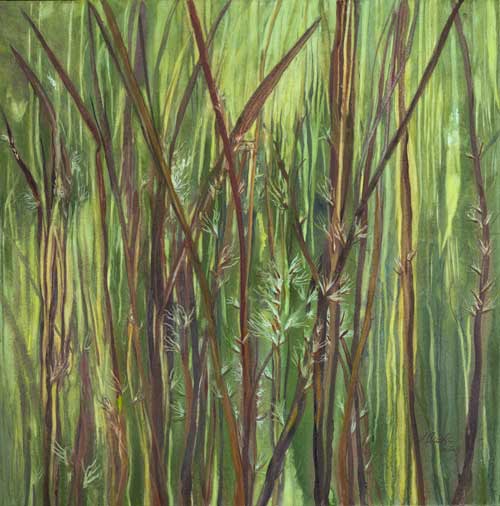
Little Bluestem


Order: Cyperales
Family: Poaceae
Genus: Schizachyrium
Species: S. scoparium

Identifying Characteristics:

-This native perennial grass is 2-3' tall and tufted at the base. The culms are tan or reddish brown, hairless, and terete; the base of each culm is erect, rather than decumbent across the ground.
Alternate leaves are produced primarily along the lower half of each culm. The leaf blades are up to 10long and ¼" across, light green or light blue, hairless or slightly pubescent, and curling outward. The leaf sheaths are light green or light blue, hairless or slightly pubescent, and finely ribbed.


Special Adaptations:

-The preference is full sun and mesic to dry conditions. Different kinds of soil are tolerated, including those that contain clay-loam, gravel, or sand. Less fertile soil is preferred because of the reduced competition from taller vegetation. Because of its C4 metabolism, Little Bluestem develops primarily during the warm weather of summer and early fall, and it has excellent drought resistance.

- Habitats include hill prairies, gravel prairies, sand prairies, black soil prairies, clay prairies, scrubby barrens, rocky slopes of thinly wooded bluffs, sandy savannas, hilltop glades (limestone, sandstone, or shale), sand dunes, gravelly areas along railroads, and abandoned fields.

-Little Bluestem is often used in prairie restorations and it is occasionally found in gardens as an ornamental grass. In Illinois, this is one of the dominant grasses of hill prairies

Wednesday, October 6, 2010

Prairie Dropseed


Order: Cyperales
Family: Poaceae
Genus: Sporobolus
Species: S. heterolepis

Identifying Characteristics:

- Taking up to five years to mature from seed, the adult dropseed can range from 1-4 feet tall and can survive over multiple growing seasons, as it is a perennial plant.

- its long luscious green leaves grow in bunches around a circular base and are no more than 1/8th of an inch wide. The leaves range in color from a rich green hue in summer to a golden rust complexion in the fall. From late July to mid-September, the grass blooms with rusty-tan flowers.

Special Adaptations:

- Native Americans were known to grind the seeds of the grass to make a tasty flour, and several species of birds find the grainy seeds a very edible treat.

-The preference is full sun, mesic to dry conditions, and soil that is loamy, rocky, or gravelly. Because the seeds are difficult to germinate, it is easier to propagate this grass by dividing the dense tufts of leaves. Once it becomes established at a suitable site, Prairie Dropseed is long-lived

- Habitats consist primarily of hill prairies, gravel prairies, dolomite prairies, black soil prairies, cemetery prairies, prairie remnants along railroads, and limestone glades. Less often, Prairie Dropseed has been found in savannas, thinly wooded rocky bluffs, and grassy fens. This grass is found primarily in high quality natural areas. It is also cultivated as an ornamental plant.

Indian Grass


Order:Cyperales
Family: Poaceae
Genus: Sorghastrum
Species: S. nutans

Identifying Characteristics:

-This native perennial grass is 3-7' tall and unbranched

-It typically consists of tight bunches of flowering culms and their leaves. The culms are terete, glabrous, and light green to pale yellow.

-The blades of the alternate leaves are up to 2' long and ½" across; they are dull green to dark green, flat, and hairless

-The leaf sheaths are dull green, hairless, and open. The nodes of the culms are slightly swollen, dark-colored, and covered with fine silky hairs (at least when they are young). Most of the leaves are located along the lower halves of the culms

-The branchlets are some shade of golden brown or tan, mostly glabrous, and slender. However, the tips of the branchlets underneath the spikelets usually have fine silky hairs. Each branchlet terminates in a one-flowered spikelet about 1/4" (6 mm.) to 1/3" (8 mm.) long

Special Adaptations:

- The preference is full to partial sun and slightly moist to dry conditions. Various kinds of soil are tolerated, including those that can loam, clay-loam, sand, and gravel. Most growth and development occurs during the warm weather of summer because of the C4 metabolism of this grass. It can spread aggressively in some situations (e.g., prairie restorations).

-Habitats include savannas and sandy savannas, black soil prairies, clay prairies, sand prairies, gravel prairies, dolomite prairies, hill prairies, cemetery prairies, barrens with scrubby vegetation, limestone glades, grassy fens, fallow fields, roadsides, and areas along railroads

Sky Blue Aster


Order: Asterales
Family: Asteraceae
Genus: Aster
Species: A. oolentangiense

Identifying Characteristics:

-This native perennial plant is 1½–3' tall, and largely unbranched except at the inflorescence

-The central stem is light green and largely hairless. Near the base of the plant, are basal leaves with long narrow petioles. These basal leaves are about 3" long and 1½" across, cordate or broadly oval, and largely hairless.

-As the leaves alternate upward along the stem, they become greatly reduced in size and more narrow.

-The inflorescence is a large panicle of compound flowers that are daisy-like in appearance; this large inflorescence has a tendency to droop over somewhat. The compound flowers are about ½" across or slightly larger. They consist of about 10-25 lavender or light blue ray florets

Special Adaptations:

-The preference is full or partial sun and mesic to dry conditions. This plant is rather indifferent to soil characteristics, and can flourish in soil that loamy, sandy, rocky, or contains clay. This plant is easy to grow and drought resistant; the lower leaves are occasionally marred by powdery mildew and other foliar Habitats include mesic to dry black soil prairies, rocky upland woods, savannas, woodland borders, sandy meadows, limestone glades, clay banks, and areas along roadsides

- The flowers attract various insects, including small bees, flies, small to medium-sized butterflies, skippers, and wasps. Among these, Green Metallic bees and other Halictid bees are especially common visitors of the flowers, where they seek nectar or pollen.

Thursday, September 30, 2010

Cup Plant


Order: Asterales
Family: Asteraceae
Genus: Silphium
Species: S. perfoliatum

Identifying Characteristics:

- This native perennial plant is about 4-10' tall and remains unbranched, except for the panicle of flowering stems near the apex.

-
The central stem is thick, hairless, and four-sided.

-
The large opposite leaves are up to 8" long and 5" across, which join together around the central stem to form a cup that can hold water, hence the name of the plant. These leaves are broadly lanceolate to cordate, coarsely toothed, and have a rough, sandpapery texture.

-
The yellow composite flowers bloom during early to mid-summer for about 1-1½ months. Each sunflower-like composite flower is about 3-4" across, consisting of numerous yellow disk florets that are surrounded by 18-40 yellow or pale yellow ray florets.

Special Adaptations:

-
The preference is full or partial sun, and moist loamy soil. This plant may drop some of its lower leaves in response to a drought. Sometimes, the leaves and buds of distressed plants turn brown, growth becomes stunted, and blossoms abort in response to disease or drought. Another problem is that Cup Plant may topple over during a rainstorm with strong winds, particularly while it is blooming, or situated on a slope.

-
Typical habitats include moist black soil prairies, moist meadows near rivers, low-lying woodland edges and thickets, fens and seeps, lake borders, fence rows, and along ditches near railroads.

-
Long-tongued bees, butterflies, and skippers are common visitors and the most important pollinators of the flowers. Some short-tongued bees, wasps, bee flies, and other kinds of flies also visit the flowers for pollen or nectar.

Reed Canary Grass


Order: Poales

Family: Poaceae

Genus: Phalaris

Species: P. arundinacea


Identifying Characteristics:


- The stems can reach 2.5 m in height. The leaf blades are blue-green when fresh and straw-colored when dry. The flowers are borne on the stem high above the leaves and are pinkish at full bloom.


Special Adaptations:


- Reed canary grass grows well on poor soils and contaminated industrial site


- Reed canary grass is also planted as a hay crop or for forage. Furthermore it provides fibers which find use in pulp and papermaking processes.


- In many places, reed canary grass is an invasive species in wetlands, particularly in disturbed areas. When reed canary grass invades a wetland, it suppresses native vegetation and reduces diversity. The grass propagates by seed and rhizome, and once established, is difficult to eradicate.

Common Cottonwood


Order: Salicales

Family: Salicaceae

Genus: Populus

Species: P. deltoides


Identifying Characteristics:

- A tall tree with coarse-toothed leaves which have 2-3 small but obvious glands at top of flattened leafstalks.


- twigs usually hairless, yellowish, sometimes 4-angled on vigorous shoots


- end buds 1"; quite gummy. They have 6-7 scales and are not spicy- fragrant when crushed


- Bark smooth, yellow-green when young but on mature trees dark and ridged


- The leaves are large, deltoid (triangular), 4–10 cm long and 4–11 cm broad with a truncated (flattened) base and a 3–12 cm long, the leaf is very coarsely toothed, the teeth are curved and gland tipped, the petiole is flat; they are dark green in the summer and turn yellow in the fall (but many cottonwoods in dry locations drop their leaves early from the combination of drought and leaf rust, making their fall color dull or absent)


Special Adaptations:


- It needs bare soil and full sun for successful germination and establishment; in natural conditions, it usually grows near rivers, with mud banks left after floods providing ideal conditions for seedling germination; human soil cultivation has allowed it to increase its range away from such habitats